
Link building companies sell one of a few things: outreach that earns placements on other sites, access to publishers who accept sponsored content, or content and PR that attracts links on its own merit. To compare them, look at the method, how each link is labelled, how relevant the publishers are and what you can check afterwards.
The rest is detail. It still matters, because two offers that look identical on a sales page can carry very different risk.
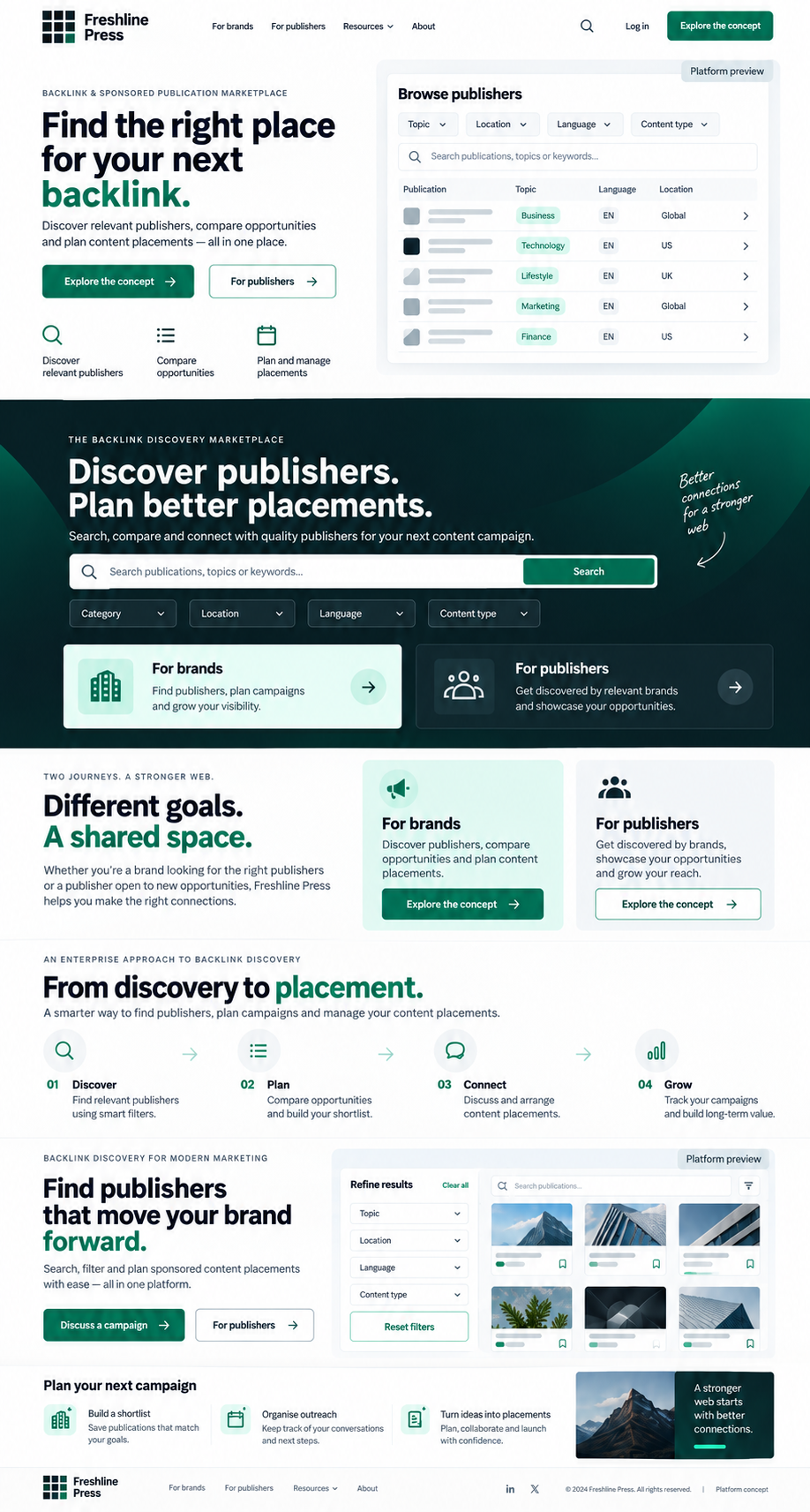
A note on where this comes from. FreshlinePress is developing a marketplace concept that connects brands with publishers for sponsored placements, so we have a stake in this topic. The comparison below covers every model, including ours, and none of it promises rankings. No honest provider can.
What do link building companies actually sell?
Most link building companies sell placements, content, or a mix of the two. The name on the package (guest posts, niche edits, PR links, sponsored articles) tells you less than three facts: who chooses the site, who writes the text and who decides how the link is marked.
If you want background on the practice itself, Wikipedia’s overview of link building is a fair place to start.
Guest post outreach services
Guest post outreach is the classic agency model. The provider pitches article ideas to editors, writes the piece once a site says yes and reports the live URL. Good outreach teams work from a topical list and accept that most pitches go nowhere. Weaker teams send the same template to hundreds of guest posting sites and take whatever lands.
Ask to see the kind of sites they pitch before you sign. If their list of guest posting websites accepts anyone on any topic, treat that as a warning.
Sponsored content marketplaces
A marketplace lists publishers that accept paid articles and lets you choose. You usually see the site, its topic and its conditions up front, so publication outreach gets faster and more predictable. The catch is that the link is paid. It should be disclosed and marked as sponsored, which we cover below.
FreshlinePress is planning this model. Our page on link building services for brands explains how we approach briefs, shortlists and review responsibilities.
Digital PR and content marketing for link building
With digital PR, the company creates something worth citing, such as original research, a useful tool or a sharp expert comment, and pitches it to journalists or bloggers. Links arrive as editorial mentions. Results are harder to forecast and often slower. Even so, these are the most natural links a site can earn, and content marketing for link building leaves you with assets you keep using long after the campaign ends.
Link publishing on networks built to sell links
Some providers own groups of sites whose main purpose is selling links. Prices look attractive and delivery is quick. Google’s spam policies treat link schemes as a violation, and sites that exist mainly to pass links are the obvious target. If a provider won’t name the domains before you pay, ask yourself why.
How do link building services compare side by side?
Link building services differ most on three things: how much control you get, how the link is disclosed and how predictable the outcome is. The table gives a rough picture. Any single provider can be better or worse than its category.
| Model | Who picks the site | Link labelling | Predictability | Main risk |
|---|---|---|---|---|
| Guest post outreach | The agency, with your approval if you ask for it | Often unclear, so agree it in writing | Medium | Weak sites padded into reports |
| Sponsored content marketplace | You, from listed publishers | Sponsored, disclosed to readers | High | Paying for sites with little real audience |
| Digital PR and content | The journalist or editor | Editorial | Low | Spend with no guaranteed links |
| Private link networks | The seller | Usually hidden | High on delivery | Search penalties and wasted budget |
Predictability and safety pull in opposite directions here. Where on that line does your site belong?
Which questions should you ask a link building company before paying?
Ask questions that force specific answers: which sites, which topics, who writes, how links are marked and what proof you get. A vague answer to any of them tells you more than a polished pitch deck.
This checklist works for most providers:
- Can I approve every site before publication?
- Do the publishers place content on topics close to mine, or on anything at all?
- Who writes the article, and can I review it before it goes live?
- How will the link be marked: rel=”sponsored”, nofollow or followed?
- Will readers see that the post is sponsored?
- What happens if the post is removed or edited later?
- Do you report live URLs, or only totals?
Pay attention to the answer about removed posts. A provider that has never thought about it has probably never needed to.
How should paid links and sponsored content be labelled?
Paid links should carry rel=”sponsored” (or nofollow), and the article itself should be clearly marked as sponsored for readers. Search engines ask for the first. Consumer protection rules in many markets expect the second.
Sponsored content has a long history in publishing, and disclosure is what keeps it from being hidden advertising. A company offering followed paid links with no label is selling you a risk that lands on your domain while it keeps the fee.
FreshlinePress plans to apply one rule to every paid placement: the link is marked rel=”sponsored”, and the post is labelled, carries a named author and stays on topic for the publisher.
Red flags when comparing link building services
The same warning signs come up again and again:
- guaranteed rankings or guaranteed positions
- a single third-party “authority” score used as the only measure of quality
- no list of domains before payment
- publishers that cover every topic, from casinos to recipes
- refusal to discuss link attributes at all
One of these alone doesn’t prove a provider is bad. When you see two or three together, it usually is.
Where does a link building strategy fit before you hire anyone?
A link building strategy comes first. It decides which pages need links, which topics those links should come from and how many placements make sense. Without one, every offer looks equally good, or equally bad.
Start with pages that already convert and sit near the first page of results. Map the topics and publication types that would be credible sources for those pages. Then judge each company against that map, not against its own package names.
Campaign link management matters after you buy, too. Keep a simple record for each placement: URL, publication date, anchor, link attribute and who to contact if something changes. Most problems with paid placements surface months later, when a post gets edited, moved or quietly deleted.
FAQ
Are link building companies worth the money?
They can be, if the sites are relevant, the links are labelled correctly and you can check every placement. If a company can’t show you the domains or the live URLs, you have no way to judge it. Value depends on transparency as much as on price.
What is the difference between guest posting and sponsored content?
Guest posting is usually earned through outreach: an editor accepts the piece on its merit. Sponsored content is paid publication, so readers should see a label and its links should use rel=”sponsored”. Many “guest posts” that agencies sell are actually paid, so ask which one you’re buying.
Can a link building service guarantee rankings?
No. Rankings depend on many factors outside any provider’s control, including the search engine itself. A provider can commit to deliverables such as approved sites, published URLs and agreed link attributes. Treat a ranking guarantee as a red flag.
How many links should a campaign include?
It depends on the pages you want to support and on what comparable sites in your topic have earned. Set the number from your strategy, and be wary of packages that sell the same fixed volume to everyone.
Author: Sophie Laurent, responsible for editorial review at FreshlinePress
Last updated: November 2026
Leave a Reply